
From Standing Apart to Standing Together:
The Social (Re)Organization of Biological Field Stations
Through Computer-Supported Cooperative Work
Erin Robinson, PhD | Information Science, University of Colorado Boulder
Full
Dissertation
Recorded Talk
Abstract and summary
Cite this work as: Robinson, E. (2025). From Standing Apart to Standing Together: The Social (Re)Organization of Biological Field Stations Through Computer-Supported Cooperative Work [University of Colorado Boulder]. https://doi.org/10.25810/2Y0J-FZ68
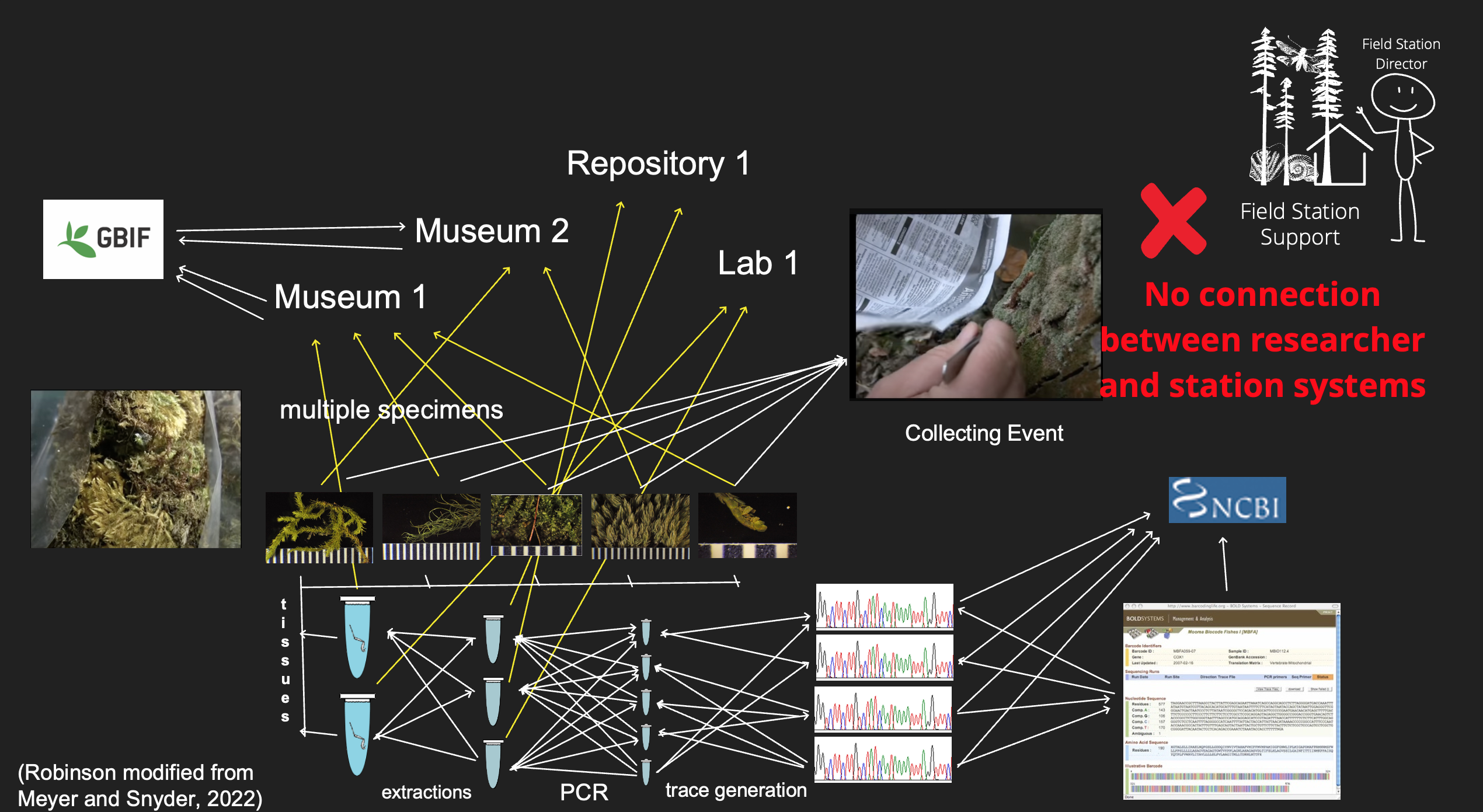
The Field Station ‘Connection Problem’
(As described by field station directors in the study)
Researchers come to work at a field station, but what happens after they leave?
Results are not shared back to field stations in a systematic way.
Field station communities lose insights significant for future research and management.
Field stations fail to receive recognition for their contributions to science.
Research Question:
How could field stations, individually and collectively, address the problems they feel from being disconnected from the research trajectory and larger scientific enterprise?
Chapter Snapshots
This dissertation is a ‘stapled dissertation’, but it differs from many others in that all three chapters draw on a single dataset. The dataset contains semi-structured interviews and field notes as the foundation for analysis across chapters 2, 3, and 4. This material was collected between March 2022 and March 2025. In total, I collected data from 20 unique stations through fieldwork and in three phases of semi-structured interviews: August 2022, June 2023, and November 2024. The stations represent a wide range of ages, locations, seasonality, and capacity.
Chapter 2:
The Social Organization of Field Station-Supported Research Projects
Includes 20 stations, researchers, and field station directors
Key Contribution: ‘Dark projects’—not digitally registered in the scientific enterprise—lack connections to their resulting downstream outputs and upstream creators, funders, and contributors, like field stations.
Chapter 3:
The Integral Work of Biological Field Stations in Scientific Investigation
Includes 14 stations, focused on field station directors
Key Contribution: ‘Boundary negotiating infrastructure’, contrasting stable, boundary infrastructure (Bowker and Star, 1999), is unstable, ephemeral, and labor-intensive knowledge infrastructure required for the highly situated field research.
Chapter 4:
Improving Digital Connections to Field Stations through Infrastructure Interventions
Intensive design work with one field station director across two field stations.
Key Contribution: An application of design ethnography (Pink et al., 2022) to develop and test infrastructure interventions based on Chapters 2 and 3. Codified these results in the FAIR & CARE Toolkit for Field Stations to connect to the Global Research Infrastructure.